Annex
This chapter contains technical data and certificates.
Technical Drawings
Note
You can download the CAD files from our Download Center under: 03_Proemion Tools Software > 01_Software.
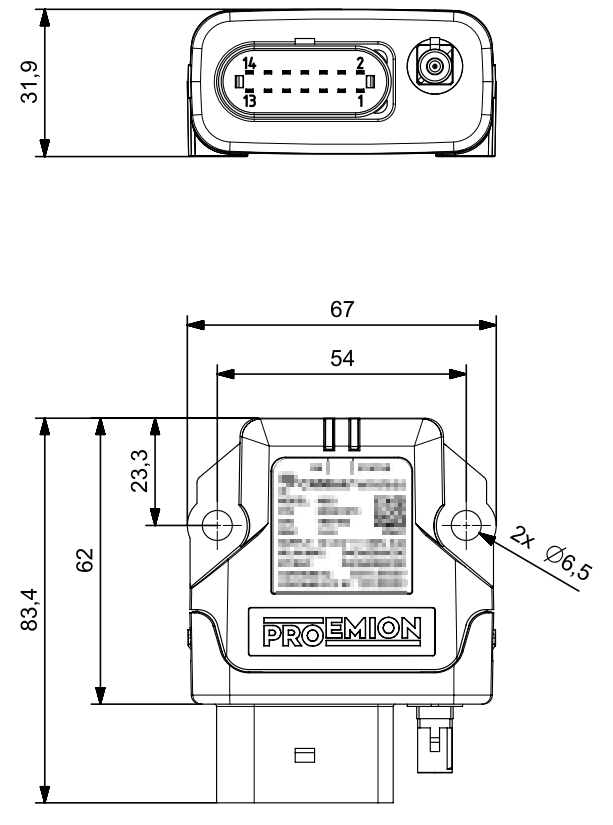
Note
The dimension for the CANlink wireless 4001 are equal to the dimensions of the CANlink wireless 4003. The only difference is the external FAKRA connector at the CANlink wireless 4003.
Technical Data
This chapter contains information on the technical data of the device.
Mechanical
| Parameter | Value |
|---|---|
| Dimensions width/height/depth [mm] | 67 / 84 / 32 |
| Protection class | IP6K7 (with mounted vehicle plug) |
| Temperature range | -40 °C ... +80 °C / -40 °F ... +176 °F |
| Weight | ≤ 80 g |
| Material handling equipment | Qualified referring to Standard EN 12895. |
| Earth-moving machinery | Qualified referring to Standard ISO 13766-1. |
| Road vehicle equipment | Qualified referring to Standard ISO 16750-2 for environmental conditions and testing of electrical and electronic equipment. |
Electrical
| Parameter | Value |
|---|---|
| Supply voltage range terminal 30 | Rated voltage 12V / 24V Tolerance ±50% (range 6V to 36V) |
| Power consumption, at 24 V (Operating Ø) | < 100 mA |
| Power consumption in sleep mode | < 1 mA |
| Average power consumption | < 2 W |
| Electromagnetic compatibility (EMC) | Qualified referring to Standard EN 61000-6-2 for immunity in industrial environments. |
| Processor | ARM® Cortex M7 based STM32 (400 MHz) |
| Memory expansion Program Flash | 1 MB |
| Data Flash memory expansion | 16 MB |
| Memory expansion FRAM | 8 kB |
| Memory expansion SRAM | 564 kB |
| LEDs | 2 LEDs (RGB) |
Interfaces
Note
Please be aware that the measured performance values were determined in the free field without significant interference or signal dampening.
The maximum range, latency and the possible message throughput may vary considerably depending on the environmental influences, setup condition, the used antennas and, if applicable, the hardware installed for the Wi-Fi infrastructure.
Please consider these values just as approximate reference values which can be achieved in a specific test setup under ideal conditions.
It is the system integrators responsibility to verify the connection stability and performance under real ambient conditions as part of the final application and setup.
When designing the application and programming the control unit, it is important to ensure that certain latency times and connection interruptions are tolerated by the control and treated accordingly.
An end-to-end monitoring of the message transmission is recommended in any case.
Please note that the quality of the radio connection depends largely on external influences and cannot be guaranteed at any time.
It is therefore essential to provide appropriate error handling in the application for any delays or connection interruptions.
| Parameter | Value |
|---|---|
| CAN interfaces | 2 (no galvanic isolation) |
| CAN specification | - CAN - CANopen (ISO 11898-22016, SAE J2284-1, SAE J2284-5) |
| Maximum CAN baud rate | 1 Mbit/s (CAN, CANopen) |
| Digital OUT | 1 digital output - Terminal 30 switching 6 VDC - 36 VDC - max. output current 500 mA - max. switch frequency 10 Hz - Overvoltage protection up to 36 VDC - Reverse voltage protection up to -36 VDC - incl. diagnostic and analog read back of output voltage The digital output visualizes an active (Wi-Fi TCP/SPP/BLE) connection, if the respective TCP/SPP/BLE interface is enabled and the Digital Output option is enabled. The option can be enabled by writing value 1 to the object in 0x3333:0x6E, 0x6F or 0x70. See also Digital Output |
| Analog IN | 2 analog inputs - Measurement range 0 VDC to 15 VDC - Input resistance 20 kOhm - Resolution 12 bit - Sampling rate 20 Hz - Overvoltage protection up to 36 VDC - Reverse voltage protection up to -36 VDC - Tolerance ± 1 % of measurement range end value (at 25 °C) |
| Terminal 15 | Analog input - Measurement range 0 VDC to 36 VDC - Input resistance 20 kOhm - Resolution 12 bit - Sampling rate 20 Hz - Overvoltage protection up to 36 VDC - Reverse voltage protection up to -36 VDC - Tolerance ± 1 % of measurement range end value (at 25 °C) - Low-to-High Transition Wakes up the device from SleepMode |
| Operating modes | - Bridge Mode Device connection to (up to seven) device(s) - Gateway Mode Device connection to third-party device, such as a laptop or mobile phone or service device Both modes can be achieved with a Wi-Fi, Bluetooth or BLE connection |
| Bluetooth Standard | Bluetooth classic (2.1 EDR) |
| Bluetooth Low Energy | V5.0 with long range support (Bluetooth LE) |
| Wi-Fi Standard | - IEEE 802.11a/g - IEEE 802.11b - IEEE 802.11n |
| Wi-Fi encryption | - WPA/WPA2 Mixed |
| Wi-Fi transmission rate | - IEEE 802.11a to 54 Mbit/s - IEEE 802.11b to 11 Mbit/s - IEEE 802.11g to 54 Mbit/s - IEEE 802.11n to 65 Mbit/s |
| Data transfer rate CAN messages per second that can be transmitted without data loss Tested with Baud rate 1 Mbit/s |
- Bluetooth Single point 2,000 CAN messages per second (Server to Client) - Wi-Fi Access Point, Single Point 4,000 CAN messages per second - Wi-Fi Infrastructure mode Single Point 4,000 CAN messages per second - BLE, Single point 500 CAN messages per second (Server to Client) |
| Average latency period for transmission of a single CAN message Tested with Baud rate 1 Mbit/s |
- Bluetooth Bridge Single Point 23 ms - Wi-Fi® Bridge Single Point 9 ms |
| Range | Each wireless interface is tested to verify full performance over a range of 100m Longer range may be expected under certain environmental conditions, and local weather and choice of aerial can affect range. |
| Antenna Connector | - 4001 internal antenna - 4003 FAKRA connector (male), code I IMPORTANT: to avoid losing the radio approval of the Wi-Fi module, only use approved antennas |
| Buffer sizes | - Wireless receive buffer 525 messages- CAN receive buffer 275 messages |
Protocols
| Protocol | Available |
|---|---|
| Layer 2 | Yes |
| CANopen | Yes |
| Customer-specific | On request |
| TCP | Yes |
| Serial Port Profile (SPP) | Yes |
| RM Byte Command Protocol | Yes |
Status Indicators
| Variant | Status indicator |
|---|---|
| 4001 | 2 RGB LED |
| 4003 | 2 RGB LED |
Certification and Qualification
The device has been certified and qualified according to the valid standards and regulations.
For more information on the corresponding approval tests, please contact the Proemion support.
Note
We will send you an overview of national approvals on request.
Please contact our support. See chapter Service and Support.
Hereby, Proemion GmbH declares that the radio equipment type CANlink® wireless 4000 is in compliance with Directive 2014/53/EU.
The full text of the EU declaration of conformity is available at the following internet address Declaration of Conformity.
Note
Further certificates, such as FCC, are also available at our website Declaration of Conformity.
Note
Further listing details of the Bluetooth SIG standard can be found at the Bluetooth Declaration Details.
E1
ECE Regulation No. 10 (Revision 6)
Approval number 10R-06 9612
Abbreviations
| Abbreviation | Origin | Notes |
|---|---|---|
| CTO | Custom Transmit Object | Proemion's proprietary implementation of PDO configuration. Requires Proemion Configurator |
| DOD | Device Object Dictionary | Proemion's proprietary format for specifying the objects and data to configure a CANlink device with the Proemion Configurator |
| PAN | Personal Area Network | A (Bluetooth Classic) ad-hoc wireless connection that allows the devices to communicate directly with each other. |
| PDO | Process data objects | Used in CANopen for broadcasting high-priority control and status information, consisting of a single CAN frame and up to 8 bytes of pure application data |
| TPDO | Transmit PDO | Transmission from the Proemion device |