Important Device Information
More technical information can be found in the Annex.
Device Elements
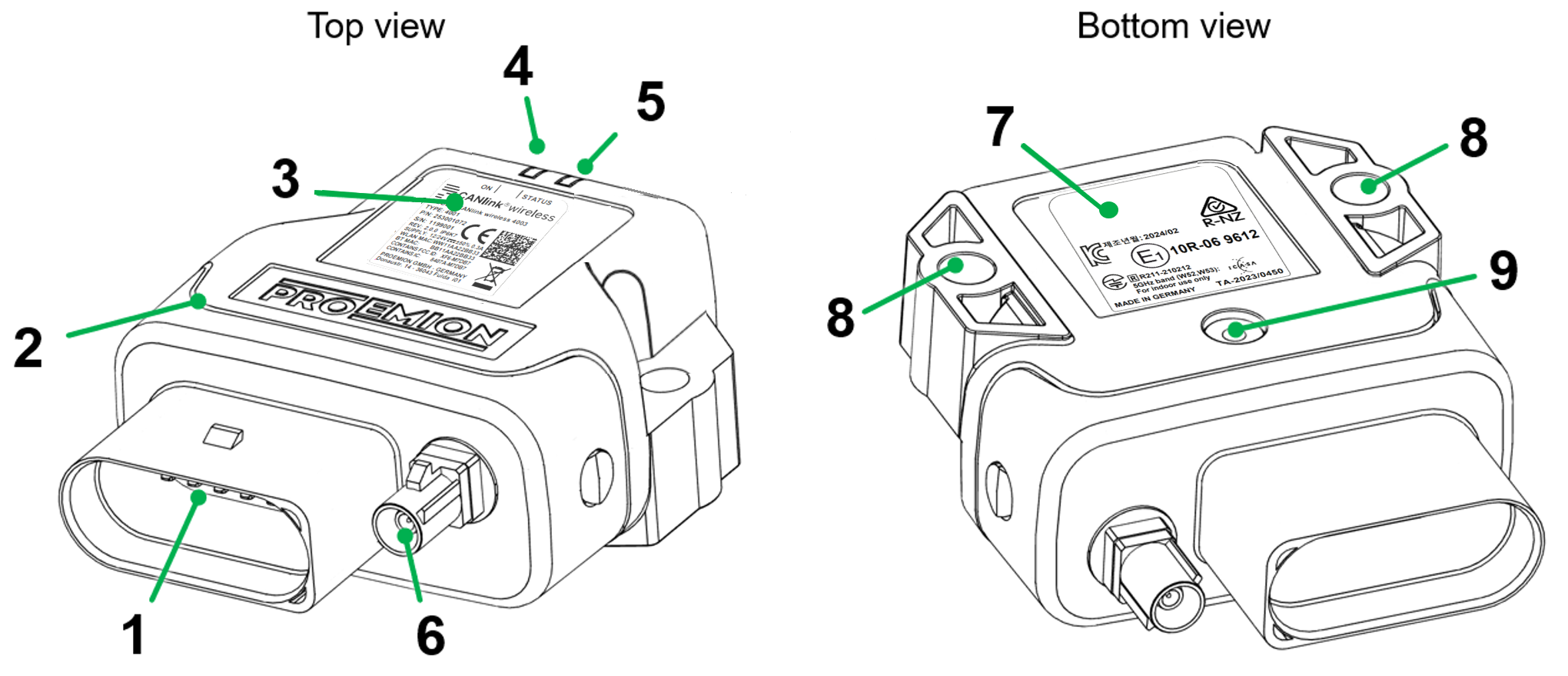
| # | Item |
|---|---|
| 1 | Main plug connector |
| 2 | Housing |
| 3 | Type label top |
| 4 | LED On |
| 5 | LED Status |
| 6 | RF antenna connector |
| 7 | Type label bottom |
| 8 | Mounting holes |
| 9 | Pressure compensation element |
Note
The CANlink wireless 4001 does not feature an external antenna connector. The antenna is integrated in the device.
Type Label
The type label on top provides the following information:
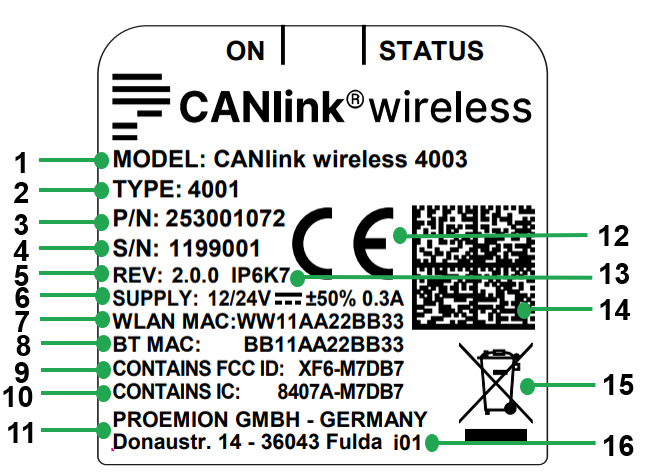
| # | Item |
|---|---|
| 1 | Model designation |
| 2 | Type |
| 3 | Part number |
| 4 | Serial Number |
| 5 | Hardware version |
| 6 | Power supply |
| 7 | WLAN MAC address |
| 8 | Bluetooth MAC address |
| 9 | FCC-ID |
| 10 | IC-ID |
| 11 | Manufacturer address |
| 12 | CE mark |
| 13 | Protection class |
| 14 | Traceability code |
| 15 | Disposal symbol |
| 16 | Product Change Index |
The type label at the bottom provides the following information:
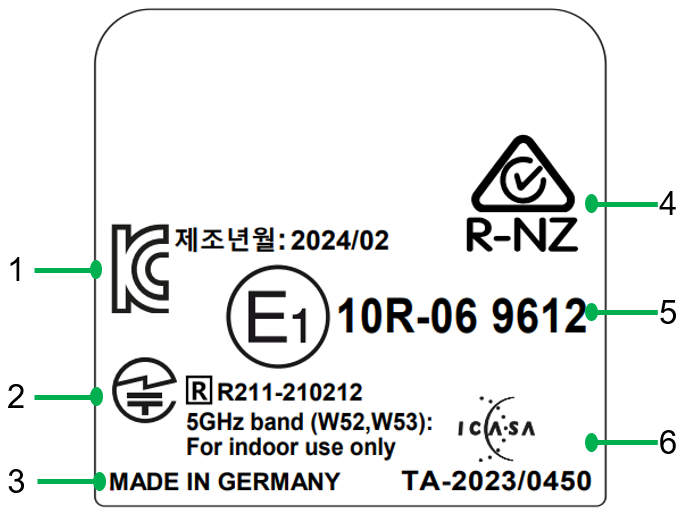
| # | Item |
|---|---|
| 1 | KC certification mark |
| 2 | TELEC certification mark |
| 3 | Country of origin |
| 4 | ACMA/R-NZ certification mark |
| 5 | ECE certification mark |
| 6 | ICASA certification mark |
Note
Use of solvents on the product label can remove or destroy product information.
Keep solvent-containing substances away from the label!
Loss of connectivity at devices with internal antenna
Please do not stick additional labels onto the device. Depending on the nature of the material, these stickers can severely impair the signal quality.
Note
The device's type label contains important information.
Do not remove the type label.
Traceability code
The traceability code contains the following information. Example:
253001072000000000001907492(W)D4CA6E868CDE(B)D4CA6E868CDD
| Item | Description |
|---|---|
| 9-digit part number: | 253001072 (P/N depends on Type) |
| Serial number 0-padded: | 1907492 |
(W) followed by the WLAN MAC Address: |
D4CA6E868CDE |
(B) followed by the Bluetooth MAC Address: |
D4CA6E868CDD |
Intended Use
The device provides access to the CAN data of a vehicle or machine in various operating modes:
CAN-CAN Bridge: wireless transmission of CAN data between CANlink wireless devices, e.g. as a substitute for CAN cables in drag chains or with remote control units.
-
CAN-Bluetooth Interface: wireless transmission of CAN data to a Bluetooth terminal device.
-
CAN-Wi-Fi® Interface: wireless transmission of CAN data to devices in the wireless network.
-
CAN-BLE Interface: wireless transmission of CAN data to a BLE terminal device, such as a phone, tablet or PC.
In Interface mode, CAN data can be transmitted to other Wi-Fi®/Bluetooth devices such as PCs, smartphones, and tablets for displaying and evaluation of data.
The device is suitable for use in mobile and stationary systems for industry, small business, agricultural, construction and forestry machinery.
Failure of safety-related functions due to deficient data transmission
Severe injury or death. The device operates using radio signals and is not authorized for use in safety-related applications. Insufficient Wi-Fi® availability, interference or malfunctioning of the device can cause faulty data transmission. Because of this, data transmission cannot be always guaranteed and under all conditions.
- Never operate the device in machines or applications where life depends on the fault-free operation of this device.
- Never rely solely on wireless devices for essential communications.
- The device is designed to be used in systems which must be checked for conformity with the respective valid legal requirements prior to putting into operation. The integrator of the device is responsible for ensuring that the device complies with all regional regulations and requirements.
- The device must only be put into operation by qualified technicians and electricians with advanced knowledge of electrical engineering and fieldbus systems
The CANlink® wireless 4000 series can be used in environments that require protection class IP6K7.
Note
Protection classes IP6K7 are only guaranteed when all connectors of the device are equipped with their corresponding connector plugs and the and the device is installed in accordance with the hints from chapter Mounting the Device.
Only use the device within the permitted temperature range and the other parameters specified in the technical data. Any use other than that described under "Intended use" is considered unintended use.
Misuse
The device does not comply with Directive 2014/34/EU and may not be used in potentially explosive areas.
Qualified Personnel
The device must only be put into operation by qualified technicians and electricians with advanced knowledge of electrical engineering and fieldbus systems. The specialist personnel must know the contents of this manual and always have access to it.
Note
Risk of Property damage.
A defective device must be inspected and repaired by a trained {company_name} service technician.
Do not open the device housing by yourself.
Note
Risk of Property damage.
Device is not installed in accordance with the setup requirements and permitted environmental conditions.
- The system integrator is responsible to install the device according to the specification and take corrective action in regards mechanical protection against soiling, water penetration and vibration.
- If necessary, install external protection shields. For example, an additional housing to protect the device from jet water.
- Install the device according to the recommended mounting position.
- Ensure that the cable management fulfils the required mechanical protection, insulation from vibration and strain.
Conformity
For details of the corresponding approval tests, see Certification and Qualification The device meets the requirements of the following standards and legal requirements:
 |
CE Compliant This device complies with the directives, standards and normative documents listed in Certification and Qualification |
 |
FCC Compliant This device complies with Part 15 of the FCC rules. Operation is subject to the following conditions: The device may not cause harmful interference. The device must accept any interference received, including interference that may cause undesired operation. See Certification and Qualification |
 |
E1 Compliant This device has been approved by the KBA (Kraftfahrtbundesamt, Federal Office for Motor Traffic) as compliant with Regulation No. 10. See Certification and Qualification |
 |
TELEC compliant for Japan This device is certified under business law  AD190040201 and radio law AD190040201 and radio law  R201-190133. The Model CANlink wireless 4003 is additionally certified under radio law R211-210212 and utilizes the 5GHz band (W52, W53): For indoor use only. R201-190133. The Model CANlink wireless 4003 is additionally certified under radio law R211-210212 and utilizes the 5GHz band (W52, W53): For indoor use only. |
 |
ISED Compliant This device complies with the directives, standards and normative documents listed in Certification and Qualification |
 |
KC compliant for Korea 기자재의 명칭: 특정소출력무선기기(무선데이터통신시스템용 무선기기) 인증번호: R-C-pRo-CLW4003 적합성 평가를 받은 자의 상호: 프로이미온 유한회사 제조자/제조국가: Proemion GmbH / 독일 |
Note
For more information about compliance, see Certification and Qualification.
Should you have any questions, simply contact the support team. See Chapter Service and Support.