The following sections provide an overview of the device's operating elements and functions as well as the intended use of the device. Additionally, it provides an overview of the available types and certificates.
For more detailed information, see Annex.
Important Device Information
Device Elements
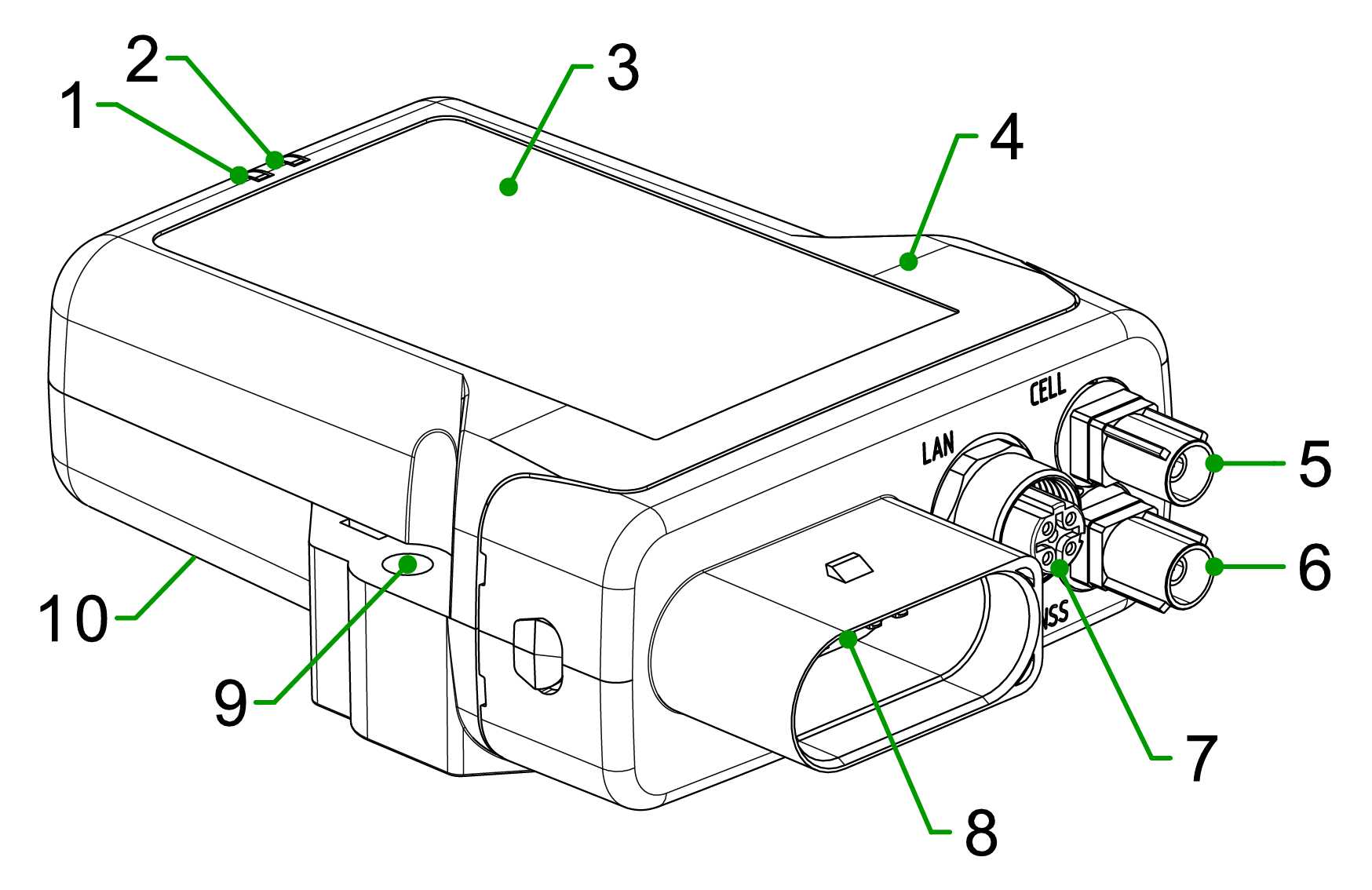
| # | Item |
|---|---|
| 1 | ON LED |
| 2 | STATUS LED |
| 3 | Type label front-side |
| 4 | Housing |
| 5 | Mobile radio antenna connector |
| 6 | GNSS antenna connector |
| 7 | Ethernet connector |
| 8 | Main plug connector |
| 9 | Fixing holes |
Type Label
The device type label is located on the front of the housing and provides the following information:
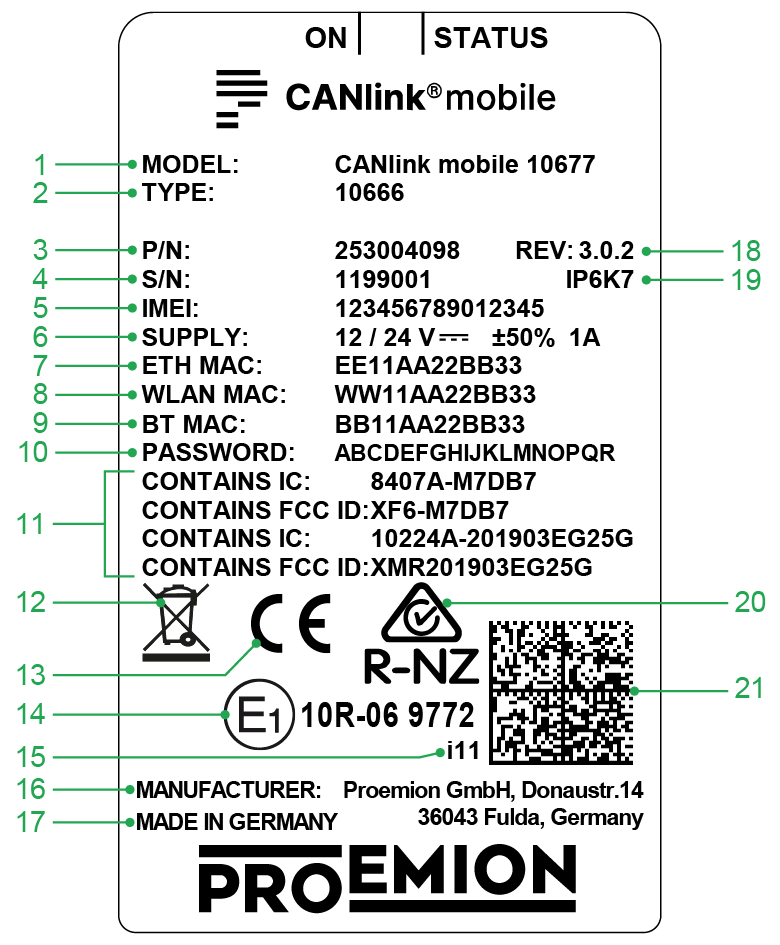
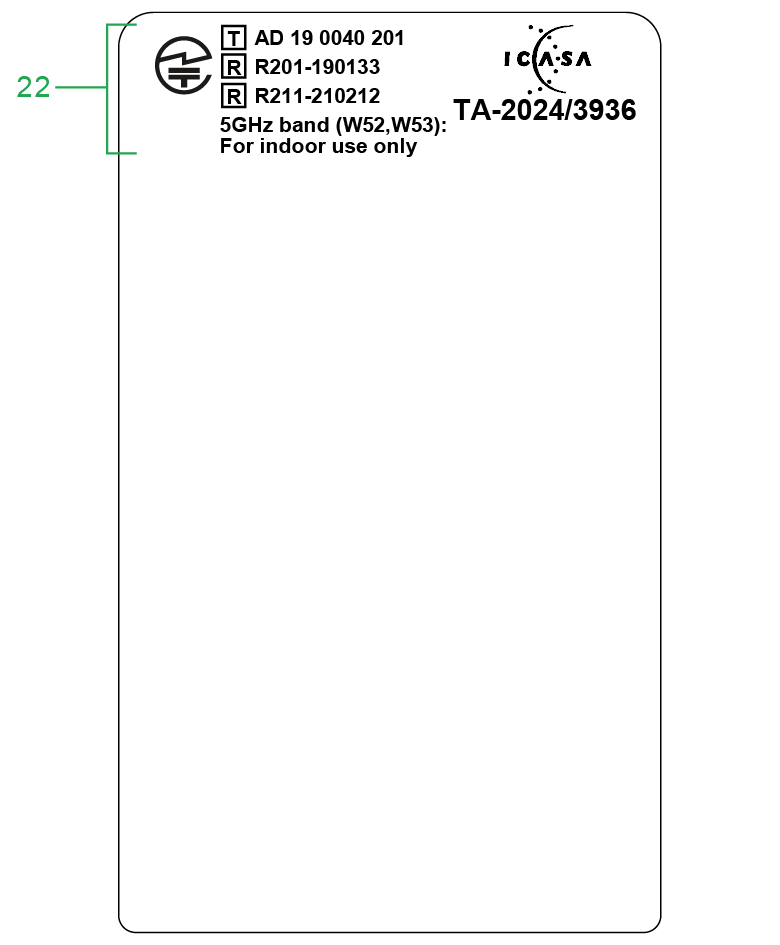
| # | Item |
|---|---|
| 1 | Model designation |
| 2 | Type |
| 3 | Part number |
| 4 | Serial Number |
| 5 | IMEI number |
| 6 | Power supply |
| 7 | Ethernet MAC address |
| 8 | WLAN MAC address |
| 9 | Bluetooth MAC address |
| 10 | Password, initial |
| 11 | IC-ID, FCC-ID |
| 12 | Disposal symbol |
| 13 | CE mark |
| 14 | ECE certification mark |
| 15 | Product Change Index |
| 16 | Manufacturer address |
| 17 | Country of origin |
| 18 | Hardware version |
| 19 | Protection class |
| 20 | RCM (Regulatory Compliance Mark, Australia/New Zealand) |
| 21 | Traceability code |
| 22 | ICASA & TRC Certification (South Africa, Taiwan) |
Note
Use of solvents on the product label can remove or destroy product information.
- Keep solvent-containing substances away from the label!
Traceability code
The traceability code contains the following information. Example:
253004093000000000001122333(I)867698041234567(W)W12233445566(B)B12233445566(E)E12233445566
| Item | Description |
|---|---|
| 9-digit part number: | 253004093 |
| Serial number 0-padded: | 1122333 |
(I) followed by the IMEI Number: |
867698041234567 |
(W) followed by the WLAN MAC Address: |
12233445566 - only certain types |
(B) followed by the Bluetooth MAC Address: |
12233445566 - only certain types |
(E) followed by the Ethernet MAC Address: |
12233445566 |
Note
The device's type label contains important information. Do not remove the type label!
Intended Use
The device is used for the wireless transmission of CAN and Ethernet data from a vehicle or stationary system according to the 2G, 3G and 4G cellular standards.
Depending on the type, you can also receive and transmit GNSS positioning data via Ethernet/Wi-Fi interfaces.
Depending on the type, you can also use the Ethernet interface to access the graphical Configuration Web User Interface, or to go online via Ethernet, and/or to grant access to the Internet for other connected network participants. The Launch Kit provides the Ethernet cable to connect to a PC.
Depending on the type, the device is equipped with an integrated battery. The integrated battery provides temporary backup in the event of power failure. It is not intended as a permanent power source for the device.
The device is suitable for use in mobile and stationary systems for industry, small businesses, earth-moving and construction machinery and in agricultural and forestry machinery.
The device can be used in environments that require protection class IP6K7.
Note
Protection class IP6K7 is only ensured when all the device connectors are provided with plug connectors or corresponding protection caps/protection plugs.
Please refer to chapter Connectors, Cables and Cleaning.
Only use the device within the permitted temperature range and the other parameters specified in the technical data. Any use other than that described under “Intended use” is considered unintended use.
MISUSE
The device does not comply with Directive 2014/34/EU and may not be used in potentially explosive areas. The device must not be cleaned with a pressure washer.
Note
Risk of Property damage.
- The device must not be permanently submerged in water and must be protected from direct high-pressure jets.
- The device must not be exposed to following non-recommended substances: oxidizing agent solutions, mineral acids, formic acid, strong alkalis, phenols, cresols and glycols. Read also the Technical Data.
- During transport or when you unscrew the M12 connector, there is a possibility that the seal (O-ring) will become loose/lost. You must ensure that the O-ring is present on the M12 connector before mounting the mating connector. If no plug is connected, a dummy plug (not a cover cap) must be used so that the O-ring is clamped between the sleeve and plug. This prevents water from penetrating and also prevents vibrations. Dummy plug example: {dummy-plug}.
QUALIFIED PERSONNEL
The device must only be put into operation by qualified technicians and electricians with advanced knowledge of electrical engineering and fieldbus systems. The specialist personnel must know the contents of this manual and always have access to it.
Risk of property damage
Do not open the device housing unless you are explicitly instructed to do so. Use only approved tools and follow the specified procedures. Unauthorized opening may damage the device and may affect warranty coverage. The device must be inspected and repaired only by trained Proemion service technicians. Contact our Service and Support.
Note
Risk of Property damage.
Device is not installed in accordance with the setup requirements and permitted environmental conditions.
- The system integrator is responsible to install the device according to the specification and take corrective action in regards mechanical protection against soiling, water penetration and vibration.
- If necessary, install external protection shields. For example, an additional housing to protect the device from jet water.
- Install the device according to the recommended mounting position.
- Ensure that the cable management fulfills the required mechanical protection, insulation from vibration and strain.
Conformity
For details of the corresponding approval tests, see Certification and Qualification. The device meets the requirements of the following standards and legal requirements:
 |
Simplified CE Declaration of Conformity |
 |
ISED Compliant This device complies with the directives, standards and normative documents. |
 |
FCC Compliant This device complies with Part 15 of the FCC rules. Operation is subject to the following conditions: * The device may not cause harmful interference. * The device must accept any interference received, including interference that may cause undesired operation. |
 |
E1 Compliant This device has been approved by the KBA (Kraftfahrtbundesamt, Federal Office for Motor Traffic) as compliant with Regulation No. 10. |
 |
TELEC compliant for Japan This device is certified under business law  AD190040201 and radio law AD190040201 and radio law  R201-190133. The Model CANlink mobile 10677 is additionally certified under radio law R211-210212 and utilizes the 5GHz band (W52, W53): For indoor use only. R201-190133. The Model CANlink mobile 10677 is additionally certified under radio law R211-210212 and utilizes the 5GHz band (W52, W53): For indoor use only. |
The full text of the declarations of conformity, as well as further certificates (e.g. FCC and Bluetooth SIG), are available at our website Declarations of Conformity (DoC)for CANlink® mobile 1000 series.
For a full list of countries where CANlink® mobile 10000 devices have a radio type approval/certification, refer to our Download Center under: 01_Proemion_Devices > 09_CANlink mobile 10000 > 01_Documentation > CANlink mobile 10000 Radio Type Approvals Country List.pdf.