All about issues
Issue types
GOAL

A goal represents a mutual objective agreed upon by the customer and Proemion, aiming to achieve a specific outcome together.
These goals must be confirmed by both the customer and the Proemion decision-makers.
Only after receiving this official confirmation can a goal be moved into the "CONFIRMED" state.
While a goal is not technically an issue, we use a custom Jira issue type to represent it.
Each goal must have a target date and be supported by epics and issues that contribute to achieving the goal.
Note
All the collaboration activities are driven by the common goals.
So all epics should be driven by goals.
To reflect this, all epics should be linked to goals using the Jira is caused by issue relation.
EPIC

An epic is a collection of tasks that contribute to a specific goal.
To represent this relation any Epic should be linked to a goal with an is caused by relation.
We have generic EPICs like BUGS epics where the goal is to have a bug-free service.
On the other hand, specific initiatives should have their specific epic.
Examples of specific epics can be "Roll out telematics for model XYZ" or "Launch OEM specific machine companion app".
An epic should be related to one or several goals of the collaboration.
Warning
Each issue must be below a parent EPIC or issue.
There must not be any orphan issues!
Note
An EPIC should not contain specific to-dos.
The specific to-dos should be described in the child’s tasks.
TASK

A TASK represents something that needs to be done to contribute to the accomplishment of the parent epic.
Relations between different tasks can be represented by sub-tasks (see below) or linking tasks.
SUB-TASK

Sometimes when - while working on a TASK - some additional tasks are identified that are required to fulfill a task.
To represent these, issues of type SUB-TASK can be used.
BUG

A BUG is describing a bug that needs to be resolved.
NEW FEATURE

Since we are developing a standard solution, feature requests are undergoing a standardized feature request workflow.
Feature requests for our standardized but configurable solution should be raised with this issue type.
DEAL

DEALs are Proemion services whose provision has been agreed upon between Proemion and the customer.
A deal does not represent any task, but is information for all project members about an agreement and its delivery state.
Paid deals reference the corresponding purchase order numbers.
Issue states
We have a custom state machine for collaboration issues.
Please see a description of the states below.
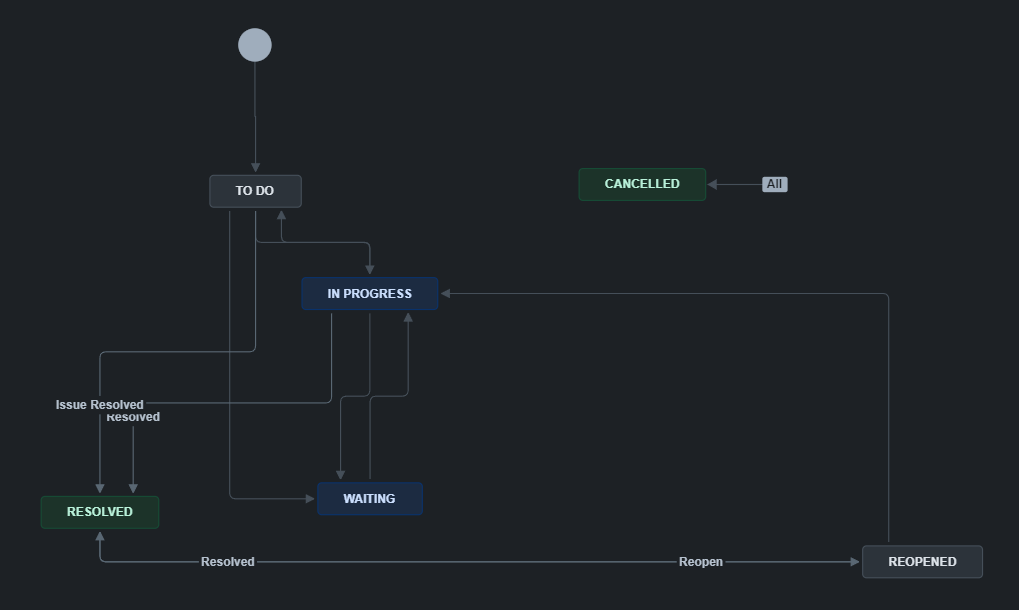
| Issue state | Description |
|---|---|
TO DO |
The issue is there but currently, nobody is actively working on it. |
IN PROGRESS |
A project member is currently working on the issue. |
WAITING |
The issue is waiting for a delivery from outside the project. |
RESOLVED |
The issue has been resolved. |
CANCELLED |
It was decided to not resolve the issue. |
Goal states
As already mentioned above, goals are no real issues.
Because of this, they have their own state machine:
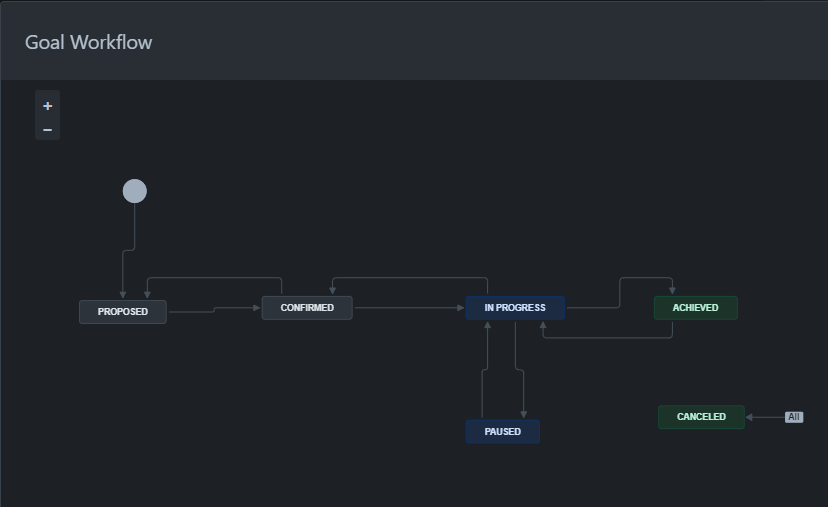
| Goal state | Description |
|---|---|
PROPOSED |
The collaboration working team has agreed on a common goal. |
CONFIRMED |
The decision makers on the customer and Proemion side have confirmed the defined goal. |
IN PROGRESS |
Work to achieve the goal is ongoing. |
ACHIEVED |
The goal is achieved as defined. |
PAUSED |
It was decided to pause the work on a goal. |
CANCELLED |
The decision-makers decided to not pursue the goal anymore. |